There are no items in your cart
Add More
Add More
| Item Details | Price | ||
|---|---|---|---|

If you grew up in the 90s, you likely remember how heavy a piggy bank felt. You remember counting coins, the friction of handing a crisp ₹100 note to a shopkeeper, and the very real feeling of watching your wallet get thinner.
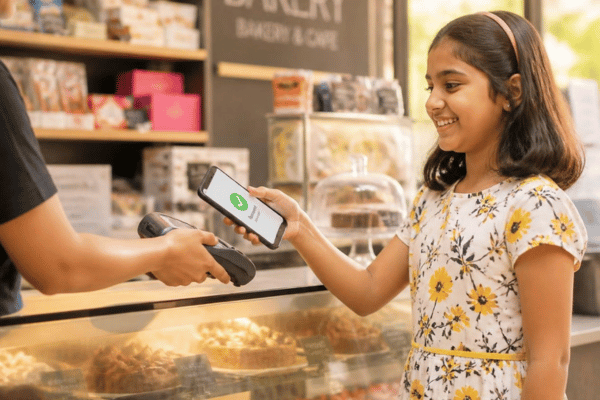
Today, our children are growing up in a completely different financial reality. To a ten-year-old in 2026, money isn't metal or paper; it is a magical QR code. It is a quick tap on a screen or an OTP that summons a pizza to the door. 😇
While UPI and digital wallets have made life incredibly convenient, they have created a massive parenting challenge: "invisible money." When money feels like an abstract number on a screen, spending it doesn't feel like a real loss. Children who grow up without feeling the physical friction of spending often struggle to budget later in life.
How do we teach the value of a Rupee when our kids never actually see one?
1. Start with "Visible Friction" (The Cash Phase): Before introducing digital wallets, bring back physical cash.
Example: For children under 10, pay their weekly allowance in ₹50 and ₹100 notes. Let them use the envelope system (one for "Spending," one for "Saving"). When they want a new toy, make them physically count the notes and hand them to the cashier. They need to experience the sensation of their "Spending" envelope becoming empty. You cannot teach the concept of a digital zero until they understand a physical zero. 🫶🏼
2. Transition to "Supervised Digital": By age 12, a child needs to learn how to navigate the digital world safely. Banning phones isn't the answer; building a mental framework is.
Example: Set up a minor bank account or use family features like UPI Circle, where you can set strict daily limits (e.g., ₹200/day). Have a "Dining Table Drill." Sit with them, ask them to make a ₹10 payment to a relative, and narrate every step: "Read the name out loud. Check the amount. Where does the receipt go?" Make the invisible process visible. 📱
3. Teach the "Work-to-Wealth" Connection: Because digital money appears instantly, kids often fail to connect it to human effort.
Example: The next time you scan a QR code for a ₹400 movie ticket, pause and say, "That ₹400 just cost me about an hour of my work today. Was this movie worth an hour of my time?" You don't need to do this constantly, but explicitly linking the digital number to your physical labor is a conversation they will never forget. 🤔
Equipping your child for 2026 doesn't mean avoiding technology; it means ensuring they control the technology, rather than the technology controlling their habits.
SkillUVA is committed to your personal development and wants you to be better on your journey as a professional; therefore, it offers you the eBook of the Month Unleash Your Fire - Ignite Your Passion & Achieve What You Desire (eBook), FREE with your VIP Membership, or buy it for Rs. 49/- only.

Dr. Ashish Parnani
Founder & Director - SkillUVA
 Launch your Graphy